Welcome to PossibNow. This is a place to learn what AI can help you do, try it on work that matters and keep the methods that prove useful. In this issue, we’ll look at how small the group experiencing AI through substantial building work remains, how a small interactive tool can give you something to inspect and improve, and what the research says about finishing a task versus learning a skill.
Andrej Karpathy estimates that about 20 million people use frontier AI professionally in math and code.
That is a tiny group in a world of billions. It is also the group he describes as seeing a very different level of capability through the work they give AI.
His October 11 post returns to an observation he made in April. He says the gap in people’s understanding of AI is widening. His rough estimates put billions of people at little or casual use, about 20 million at professional use in math and code, and about 5,000 with internal access to frontier systems. Those last two groups have different kinds of access. He calls the figures napkin math.
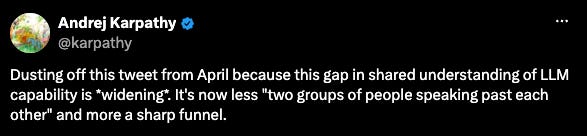
“this gap in shared understanding of LLM capability is widening.” Andrej Karpathy
I want more professionals to connect with what AI makes possible through building. Give yourself something you can use, question and change.
That is why I teach Learn AI, Use AI and Build with AI as one unified loop.
What’s Next
The February grid below gives you a way to see the scale of the idea. Each square represents roughly 3.2 million people. The small red corner represents people using AI coding tools. The image credits Benjamin Tannenbaum.
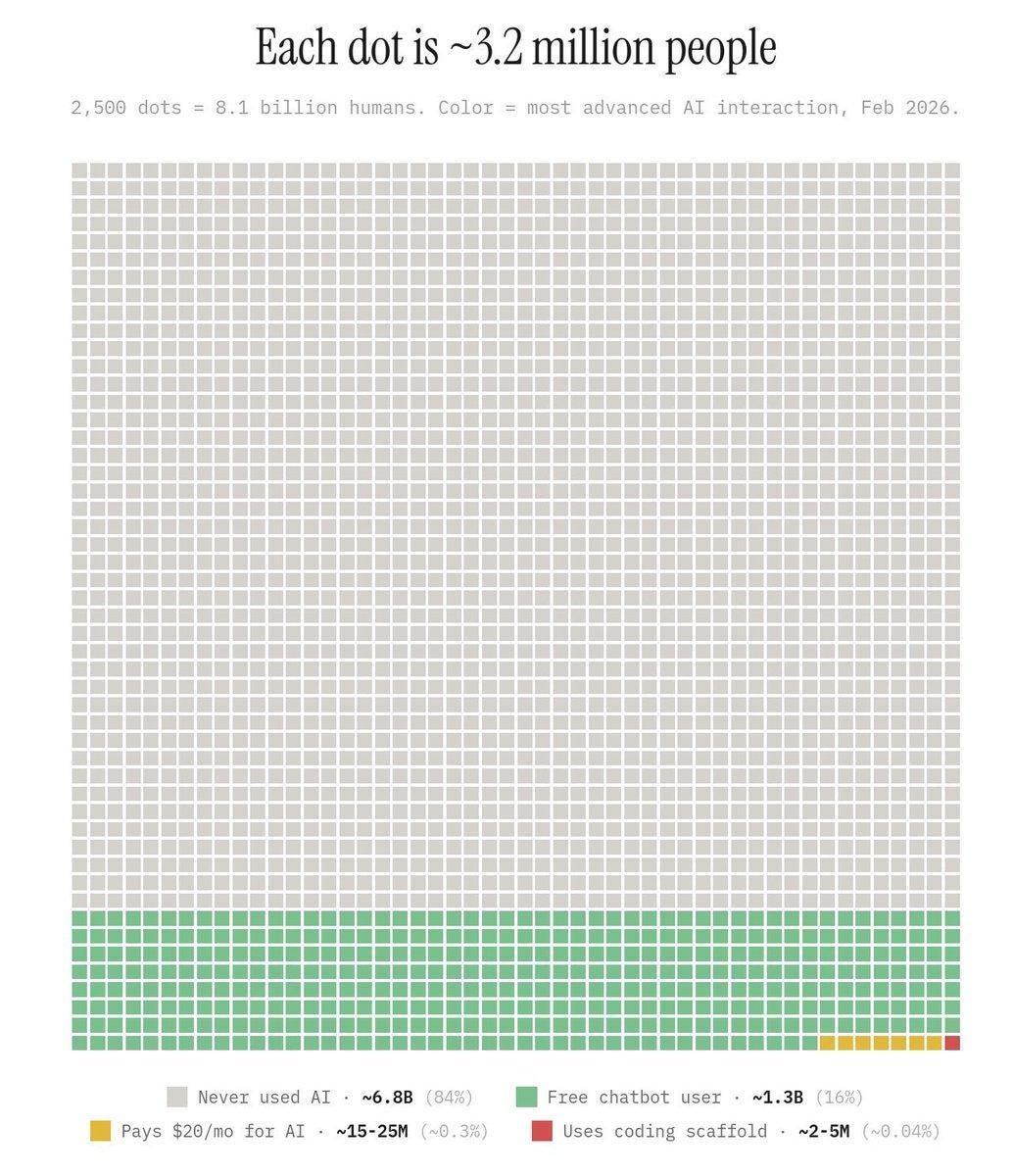
February 2026 illustration. Using Coding Scaffold
Put that grid beside Karpathy’s October post. The broad picture persists in his account. A small group experiences advanced AI through building while much of the world has barely begun.
That is the point I want you to take into your own work. The group working this way is still tiny. You can begin learning how to work with code by building something small.
I think of it almost like the Matrix. The world is code. More precisely, so much of the world we work in runs on software. Our forms, spreadsheets, dashboards and business systems follow rules that somebody put into code. Building gives you a way to connect with that world and begin shaping a small part of it.
Imagine an interactive budget explanation. You change a cost assumption and see the total move. You add a constraint and see which options remain. You can ask AI to help turn that idea into a small browser tool, then inspect the calculation and change the behavior.
The interaction matters. You have a question, make something that responds, inspect the response and decide what needs to change. You can use code as part of thinking through the problem.
Start with the work that arrives
Reading and taking a class are familiar ways to begin learning. You spend time understanding a subject, then look for somewhere to apply it.
With AI, I want you to bring the learning into the assignment itself. When something comes in, start by asking yourself this question.
What can I do to help AI do this for me?
That question asks you to look at your side of the work. What does AI need to understand? Which information should you give it? What should the result contain? Where will you need to inspect it?
You still bring your professional judgment. You know what the assignment means, which details matter and what a useful result should help someone do. Building gives you a way to make that judgment part of the process.
You begin with an assignment. You give AI the context. You inspect the result. Then you change something that would help it handle the work better.
Give yourself something to improve
This is the iteration loop I want you to practice. Build something, use it, inspect what happens and improve it.
Your first build can be disposable. A micro app. A workflow. A system that helps with one part of your day. You can keep it, replace it or delete it when it has served its purpose. What you understand about the task, and how to direct AI through it, can carry into the next assignment.
Learning needs your attention inside that loop. Ask for explanations, inspect the assumptions and try to explain the result yourself. The research below gives us a reason to distinguish a finished task from a skill you acquired.
Useful now
Simon Willison built a presentation app with AI, then asked an agent to walk through the code because he did not understand how it worked. His guide shows a way to turn a working artifact into material for learning. Ask for a walkthrough of your own small build, trace what happens when an input changes and compare the explanation with the behavior you can observe.
4 team rituals that drive AI adoption
Figma’s October 10 article gives learning a place in the working week. Its study-group pilot suggested 20 minutes of teaching and 40 minutes of practice. At Sephora, presenters began showing failed attempts alongside the finished work. At Atlassian, teams interact with a prototype before hearing the explanation. Borrow that sequence for a small shared experiment so colleagues can inspect the process as well as the result. These are reported team practices, rather than a controlled comparison of training methods.
Creative Learning, from Lifelong Kindergarten
Mitchel Resnick’s 2017 Creative Learning Spiral connects imagining, creating, playing, sharing and reflecting. Keep it beside your first build as a reminder to experiment and return to the idea after feedback. This is a general learning framework from before today’s AI tools. It gives us a useful process for practice, with reflection as part of the activity.
Thanks for reading What AI makes PossibNow! Subscribe for free to receive new posts and support my work.
What’s possible
Learning by Making with Generative AI
Matthew R. Fischer’s faculty-workshop design case brings adults into learning through making relevant artifacts, testing limitations and reflecting with peers. Some participants wanted more conceptual grounding alongside the open experimentation. That suggests a useful design choice for professional learning. Give people something to make and enough explanation to understand the attempt. The case documents workshop design and observations; it does not establish a universal learning gain.
How AI assistance impacts the formation of coding skills
Anthropic’s randomized study of 52 mostly junior developers separated task completion from understanding a new Python library. The AI-assisted group averaged 50% on the follow-up quiz, compared with 67% for the group coding by hand. Participants who used AI to build comprehension showed stronger understanding in the exploratory analysis of interaction patterns. That analysis does not prove one prompting style caused better learning. It does give us a reason to practice asking, checking and explaining while we build.
Better work, not always better workers
David Autor and colleagues studied AI-assisted patent drafting, then tested work without the tool. Assisted drafts improved, but gains on the later unassisted task concentrated among senior lawyers; the researchers detected no average gain among juniors. The junior sample was small, and the experiment used 2024 and 2025 AI capabilities. Keep those limits with the result. For professionals across fields, the useful question is whether practice leaves you better able to judge the next piece of work yourself.
Software’s centaur age may last decades
Sean Goedecke’s October 10 essay argues for learning the human and AI partnership as software work changes. He puts human value in directing the work and judging whether the result fits the intended goals. His prediction about how long that partnership will last remains an argument, rather than a measured forecast. The practical opening is immediate. Learn what judgment you contribute by working through a build and inspecting the decisions AI makes along the way.
The loop this week
Use your next assignment to practice thinking AI first and thinking with code. Begin by asking how you can help AI handle the work, then look for a part of the problem you could make interactive.
Learn to think AI first. Ask, “What can I do to help AI do this for me?” Identify the context AI needs and the judgment you will bring to the result.
Use AI to explore how code could help you think through the assignment. Which inputs or assumptions would you want to change? What would you want to see when you change them?
Build a small interactive tool with AI around one of those questions. Change an input, inspect the result and adjust the tool as your understanding develops.
Choose one question from the assignment and build.
Thanks for reading What AI makes PossibNow! Subscribe for free to receive new posts and support my work.
Get the next one on Friday.
Applied AI for professionals, by Sal Carranza. One workflow a week, free.