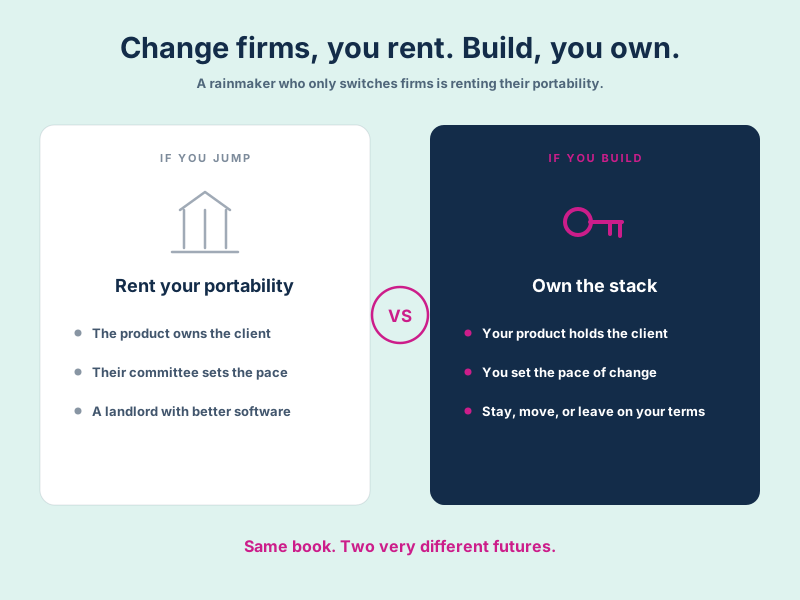
 The partners who see what’s coming won’t jump to an AI-native firm. They’ll leave to build their own.
Read Ted Theodoropoulos’s How AI Will Kill Law Firms and the obvious conclusion is that the talent flees: rainmakers grab their books and defect to whichever firm is furthest ahead on AI. That’s the move everyone is bracing for, and it’s the wrong one to bet on. A rainmaker who jumps to someone else’s AI-native firm has traded one landlord for another who happens to have better software.
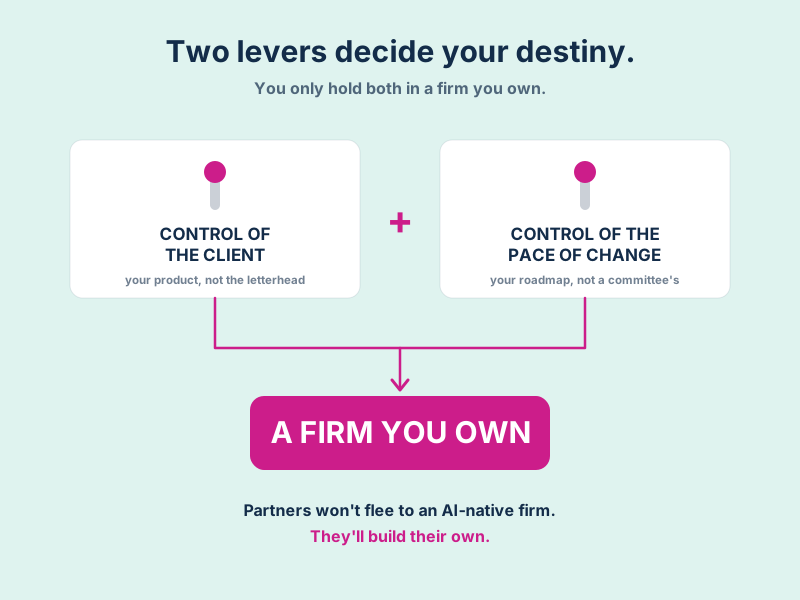
Two things break the jump. First, the more AI-native a firm becomes, the more it runs as a product, and a product-based firm owns the client, not your relationship. Second, and this is the part almost nobody is pricing in: even the best AI-native firm changes at its own pace. Its roadmap, its committee, its politics, and its risk tolerance decide how fast anything happens. Jump, and you are still a guest of someone else’s change management.
The partner who actually wants to control their destiny needs two levers, not one: control of the client, and control of the pace of change. The only place you hold both is a firm you own. That used to be a romantic idea with a brutal economic floor. It isn’t anymore, because AI compresses teams. Fewer people do the same work, and a lean boutique with a deep stack can now source the talent, judgment, and resources that used to demand Big Law’s scale.
 So the real question is not which firm you flee to. It is what you have to build to leave on your own terms, and the answer changes depending on where you sit. A rainmaker, a service partner, and a knowledge-management lead are not running the same play. Below is each route, step by step, starting with the rainmaker who wants to own the stack and then the professionals who make a lean firm actually run, each with the first build, what “done” looks like, and the exact step where most people quit.
One rule before the steps: none of this turns you into a software engineer, and none of it works on toy demos. You build one real thing, on real work, and you keep the receipts. Every path ends with an artifact you own.
The shared on-ramp (everyone does this once, first)
Before the role-specific paths split, there’s a one-time setup all three layers share. Budget a weekend, not a sabbatical.
- Stand up a workstation. Your firm’s sanctioned model, a code editor, a terminal. Done when: you can open a terminal and a project folder without a tutorial open in the next tab.
- Learn the few commands that matter. The five terminal commands you actually use, and three git commands: commit, push, and roll back. This is not computer science. It is the ability to save a working version and restore it when you break something. Done when: you can break a file on purpose, then restore the last good version from memory.
- Write your first CLAUDE.md. One page that tells the model who you are, what good output looks like in your practice, and what it must never do. Done when: the model follows your house rules without you re-explaining them every session.
That’s the on-ramp every builder shares. Now the paths diverge, because the job is different at each layer.
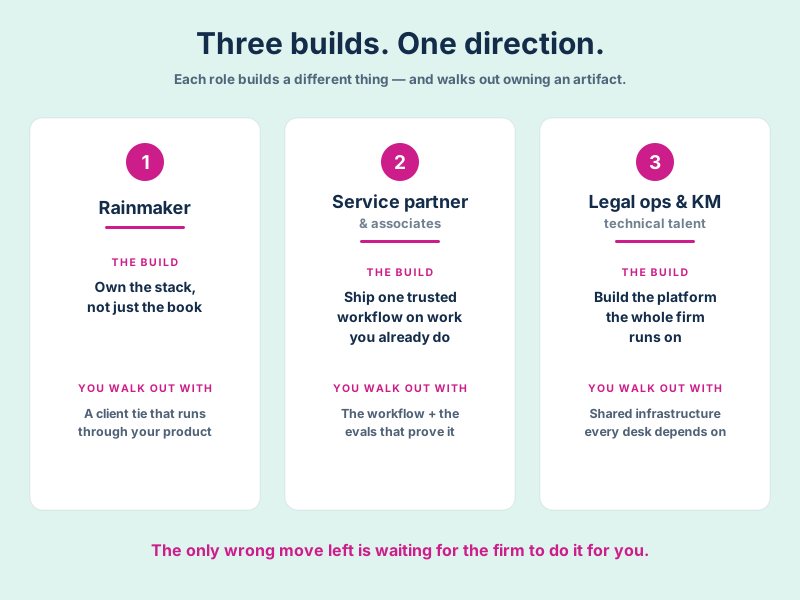
Path one. Rainmakers: own the stack, not just the book
Here is the trap almost nobody is pricing in. You are portable because your book follows your relationships, so the reflex move is to jump to whichever firm pays the most for the book. But the more AI-native a firm becomes, the more it runs as a product, and the more the actual work is done by the machine instead of by you. When the work is product-based, the firm starts to own the client, not your relationship. Jump to an AI-native firm on those terms and you have handed your book to someone else’s machine.
So portability has to mean something new. It is no longer just relationships you can carry out the door. It is a stack you own: the spec, the machine that runs your matter, and a client tie that runs through your product rather than the firm’s letterhead. You need a firm that can run the machine, and you need the machine to be yours.
There is a second force on your side if you build. AI compresses teams, so fewer people do the same work. Big Law’s moat has always been three things: top talent, judgment, and resources at scale. The moment a small team with a deep tech stack can source all three, that moat drains. A rainmaker who can run their own machine does not just get to stay. They get a new option: go out on their own, or build a lean boutique that controls the client by controlling the firm, and that sets its own pace of change instead of waiting on a committee to approve it.
- Pick your signature matter. The matter type that makes your book yours. You are going to turn it into a product the client comes to, not a favor only you can do.
- Write the spec, not the code. Document the matter end to end: intake questions, decision tree, standard positions, the red lines you never cross, and the output a client pays for. This is the blueprint of your machine. Done when: a competent associate, or a workflow, could run the matter from your document and hit your standard. Fails when: you keep the judgment in your head “because it’s too nuanced to write down.” That nuance is the asset, and right now the firm captures it for free.
- Build the machine and keep it yours. Commission the workflow that runs your spec, or build the first version yourself, but hold the asset in your name: your spec, your prompts, your evaluations, your client-facing product. Done when: the system produces a first draft you would put your name on after a review, and the intellectual property sits with you, not the firm’s platform. Fails when: you let the firm’s infrastructure own the build, because then you have only productized yourself for them.
- Set the verification standard. You own the bar: what gets checked, what triggers human review, what never ships without your eyes. Done when: everyone downstream knows the exact line where the machine stops and your judgment starts. That line is what the client pays the premium for.
- Anchor the client to the product. In a product world the client stays where the product is. Tie the relationship to the thing you built and own, not to the firm’s name on the door. Done when: if you walked tomorrow, the client follows the product, not just the friendship.
- Run the two audits. First the firm: name which workflows actually changed this year, and whether there is a machine worth running or just a press release about buying Harvey. Then yourself: with your stack owned and teams compressing, could you run your book from a lean boutique or on your own? Done when: you can say in one sentence whether your future is inside this firm, inside a better one, or inside one you build.
The differentiation: every other layer is building to stay employable. You are building to stay in control of the client. You still do not need to be the one typing at 1 a.m. Owning the stack means owning the spec, the standard, and the business model, and directing the build, not hand-coding it. But a rainmaker who only changes firms is renting their portability from whoever owns the machine. A rainmaker who owns the stack can stay, move, or leave and start something lean, because the thing the client values now lives in a system they control. Big Law’s scale stops being the only place top talent, judgment, and resources can live.
Path two. Service partners and associates: ship a trusted workflow on your own matters
You go deepest into the craft, because this is the layer most exposed to “the work gets automated.” The only exit is up, into the judgment layer, with a built system underneath you that carries your standard. You are going to ship one trusted workflow, end to end, on work you already do.
- Choose your first trusted workflow. Not the hardest thing you do. The highest-frequency, lowest-catastrophe thing: an NDA first-pass, an MSA issue-spot, a research memo, a deposition summary. Done when: you’ve picked one task you do weekly and could still check by eye.
- Map the workflow anatomy: inputs, transforms, outputs, evidence. What goes in, what the model does to it, what comes out, and what proof shows it was done right. Done when: you can draw your task as four boxes before you automate a single step.
- Build the first pass. Wire the task into a real workflow with your CLAUDE.md driving it. Start from the exemplar closest to your task and adapt it. Done when: it produces a real first-pass output on a real document.
- Encode your judgment as guardrails. This is the step that makes you irreplaceable. The red flags you catch on instinct become explicit rules. The confidentiality and privilege lines become guardrail prompts. “Always escalate when X” becomes an escalation prompt. Done when: the system stops and asks for you exactly where your judgment is required, not before and not after.
- Build the test set: golden cases and failure cases. Take five matters you handled correctly and five with known traps. Run all ten through. A workflow you can’t test is a workflow you can’t trust. Done when: it passes the golden cases, catches the failure cases, and you can prove both.
- Add the verification loop. Citations checked, sources confirmed, facts verified before anything reaches a human. Done when: output arrives with its evidence attached, so your review takes minutes instead of hours.
- Run it in parallel for two weeks. Do the work the old way and the new way side by side and measure the gap. Done when: you have numbers (time saved, errors caught) and a workflow you trust enough to lead with.
Where people quit: step four. Encoding your judgment is hard and it feels like giving yourself away. The opposite is true. I have watched it both ways. The associate who systematizes their judgment becomes the person the firm builds around. The one who hoards it stays a bottleneck the firm eventually routes around. Your deliverable here is a trusted workflow plus the evals that prove it, and that artifact is your case for becoming the judgment layer instead of the production line.
Path three. Legal ops, KM, and technical talent: build the systems the firm runs on
You already build for a living, so your path goes widest: not one workflow on one desk, but the shared infrastructure every desk depends on. You become the platform team for an AI-native firm, which is the most lucrative seat opening up in legal right now.
- Build the firm’s knowledge base first. The internal question-and-answer layer with retrieval over the firm’s own documents, playbooks, and precedent. This is the asset that stops walking out the door every time a senior partner retires. Done when: someone can ask the system a question and get the firm’s answer with a source attached, not a generic one.
- Connect the systems with MCP. Wire the model safely to where the documents actually live: iManage or NetDocuments, the DMS, intake, calendar. Connections, not copy-paste. Done when: a workflow can reach a matter’s documents without anyone exporting files into a chat window.
- Standardize the build surface and the guardrails. Decide the firm’s stack (Claude Code, Codex, the sanctioned models), the confidentiality and privilege guardrails, the secrets handling, the data-retention hygiene. Done when: a new builder at the firm inherits safe defaults instead of inventing their own.
- Ship reusable skill packs. Turn the one-off prompts floating around the firm into a versioned, team-ready library: skills with pass/fail evaluations, organized so anyone can pull the right one. Done when: two associates solving the same task pull the same tested skill instead of reinventing it badly.
- Move to agent patterns for the complex work. The router-worker-reviewer pattern: one agent triages, one does the work, one checks it, with a named human accountable at the end. Done when: a multi-step matter runs as an orchestrated workflow and accountability survives every handoff.
- Build the reliability layer. Monitoring, logging, audit trails, an incident-response plan for when AI output fails, and versioning so every change is tracked. Done when: when something breaks you reach for a log, a rollback, and a runbook, not a guess.
- Partner with a rainmaker and ship their signature build. Take a partner’s spec from Path one and turn it into the production system. Done when: a partner asks for you by name on their next build, and you have the receipts (hours saved, rework killed) to name your price.
The differentiation: you go widest and deepest on infrastructure, integrations, orchestration, and reliability. Nobody else in the firm can build the shared layer. That scarcity is your leverage, and it is why this role gets repriced first.
When this is the wrong move
None of this is free. Every hour you spend building is an hour off billable work or business development, and the short-run scoreboard will not reward you for it. If your firm’s leadership is genuinely moving, with real budget and real workflow change already underway, then duplicating that effort solo is wasted motion. Join it instead, and bring one built thing so you’re shaping the work rather than watching it.
This whole plan is insurance against the far more common case: the firm that bought the tool, ran the press release, and changed nothing underneath. The cost of building early is real and it shows up this quarter. The cost of building late is that you don’t choose your terms when the layer beneath you gives way.
So when someone says “become a builder,” know that it isn’t one act. It’s a rainmaker owning the stack their clients run on, an associate shipping a trusted workflow, and an ops lead running the platform under both. Three different builds, one direction, and the only wrong move left is waiting for the firm to do it for you.
We’re publishing the full step-by-step path for each of these in the PossibLaw library, from workstation to workflow to governance, and the hands-on version with feedback and a deployable capstone is Trazomo.
Get the next one on Friday.
Applied AI for professionals, by Sal Carranza. One workflow a week, free.
Form not showing? Subscribe at aiforhumanss.substack.com.